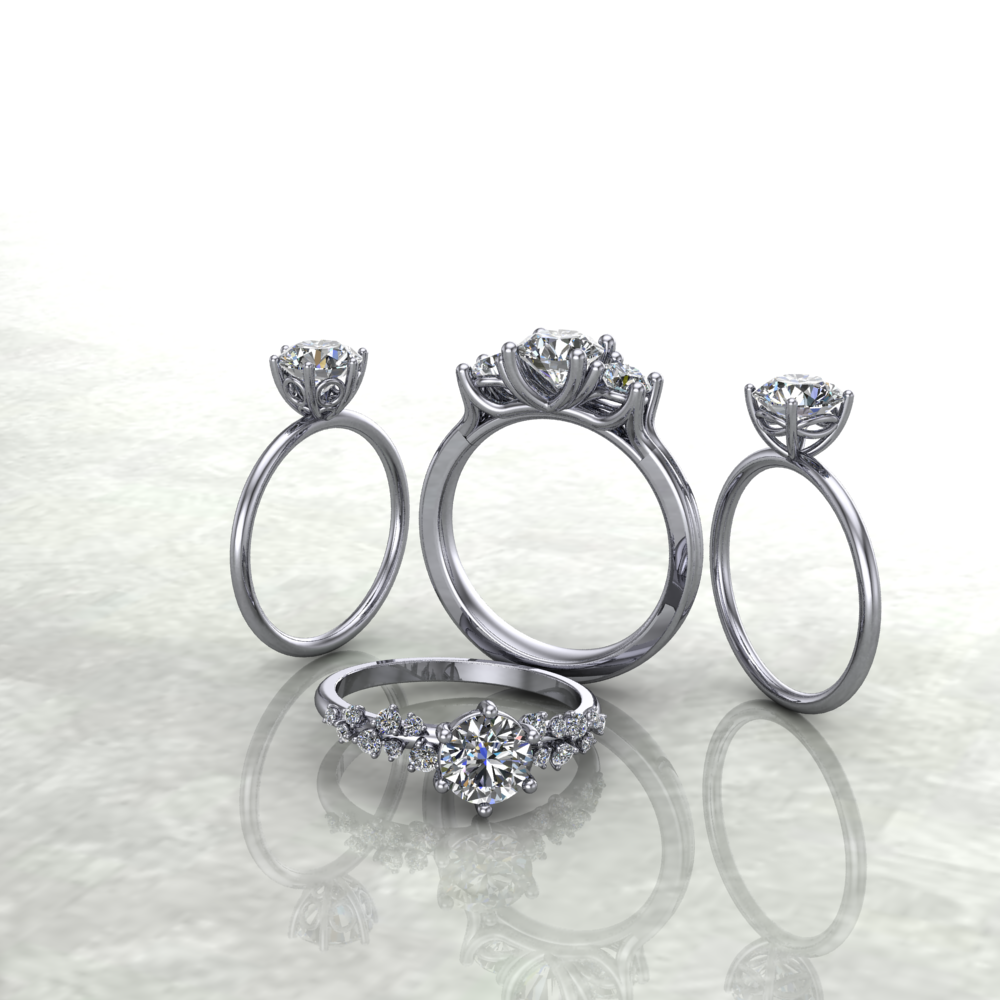

To say that a lot has changed in the jewellery industry since 1998 would be an understatement. Through 1998 to 2025 two phenomena stand out to me: the rise of CAD and the popularity of lab-grown diamonds. This is not to mention other notable changes, such as the gold price exceeding the platinum price, making the superior metal now considerably more affordable than 18k gold.
Through my training, I became a handmade purist and, along with my colleagues, frowned upon cast jewellery. In my defense, back then we were only familiar with castings from what we observed coming out of chain stores — i.e. mass-produced jewellery, which was usually cast from a handmade model. These were almost exclusively of poor quality, made with thin metals, poorly set stones, and inferior alloys.
When the (brilliant) goldsmith who trained me told me in the early 2010s that he hardly did anything by hand anymore and largely used casting, I was shocked. This was my introduction to understanding the possibilities and advantages of CAD. I started seeing it as the way forward after dealing with many goldsmiths who had also embraced it as the future of manufacturing.
So, what are the advantages of computer-aided design, printing, and casting? I can only speak for myself, but they are vast.
Solder lines are eliminated, symmetry is near perfect (if not perfect), and labour costs are drastically reduced. In fact, the only labour to consider is designing, finishing, and setting — and in most cases, this amounts to a fraction of the cost of manufacturing a piece entirely by hand.
Furthermore, my design guidelines are in accordance with my handmade standards. In fact, I have increased my metal thicknesses over time to exceed what would typically come from the bench.
The quality of the alloys used are the same as would be used on the workbench. A prime example of this is that I typically use a 10% palladium 9k white gold alloy — exactly what I use when manufacturing by hand — and there is even a 20% option available. When casting, the metals are newly alloyed, giving consistency in colour and hardness.
I hold firmly to the belief that quality is directly linked to durability, and at Studio 1980, every design and finished piece is crafted with that ethos at its core.
Lastly, I can design pieces that would be near impossible to make by hand, and no amount of detail makes a piece unaffordable.
2. Lab-Grown vs Natural Diamonds
I was a bit of a latecomer to the adoption of lab-grown diamonds — largely, once again, because I was set in my ways and found the concept foreign, even intimidating. According to my training back in the day, it was considered an error to refer to a diamond as “natural,” as the very word diamond implied that it was natural. How times have changed!
After doing my own research and, once again, talking to colleagues about the subject, my interest was sparked. The first time I held a 1ct round brilliant cut lab-grown diamond, my curiosity was ignited — and now I strongly promote LGDs as an option.
The market is dominated by top-spec stones: D-E-F colours and VVS-VS clarities. I had assumed I would have to compromise on my personal preference for stones with a bit of yellow in them — more of the I-J-K variety — but this was not the case, as they are easily available.
I have therefore concluded: why not? Lab-grown diamonds are, in every way, diamonds. You can get the stone of your preferred weight and specifications at extremely affordable prices.
I seem to have entered the industry at a favourable time to observe all these positive changes. Who knows what the future holds? What a time to be a jeweller.